Purchase orders in construction: the complete guide

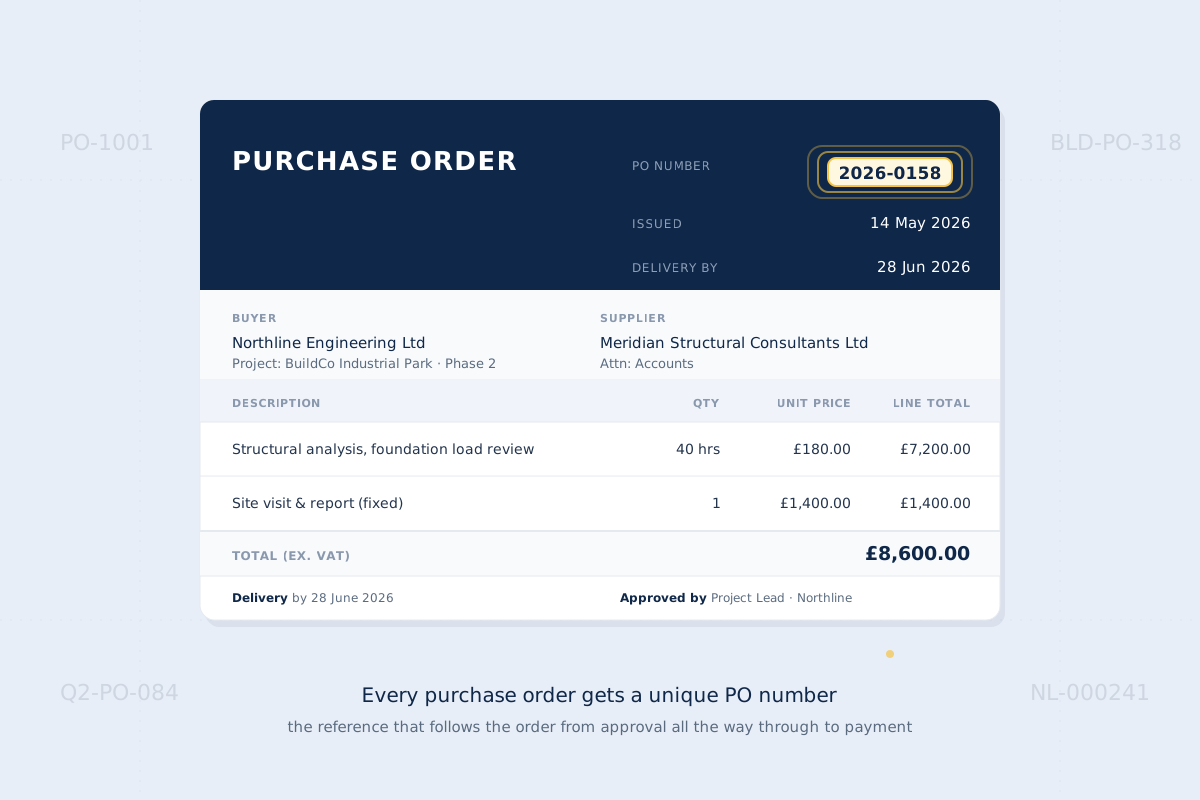
Construction purchase orders do the same job POs do anywhere else — they turn an internal decision into an external commitment. But the shape of the work is different: dozens of subcontractors, staged deliveries, retentions held back to practical completion, variations that change the price mid-project, and approval chains that run through project managers, quantity surveyors, and commercial directors before payment leaves the business.
This guide covers how construction POs actually work on a live project — the types you'll see, the fields that matter (retentions, variations, interim payments), the approval flows that make or break control, and how disciplined POs are the single biggest lever most contractors have over margin.
What makes construction purchase orders different?
Most guides to purchase orders describe the office-supplies version: someone orders a printer, the PO goes to the supplier, the supplier delivers, an invoice arrives, it gets paid. That mental model breaks the moment you apply it to a construction project. The mechanics of a construction PO are shaped by the mechanics of a construction job, and the differences are worth being explicit about:
| General PO | Construction PO | |
|---|---|---|
Duration | Days to weeks | Months to years |
Payment cycle | Invoice → 30 days | Monthly valuation → interim payment |
Retention | None | 5–10% held to practical completion |
Variations | Rare | Common; typically 5–15% of PO value |
Approval chain | Usually one person | 2–4 approvers depending on value |
Scope at PO stage | Well defined | Often refined during execution |
Ties to | A cost centre or budget line | A specific project, work package, and cost code |
Matching | Straight two- or three-way match on invoice | Match on each interim valuation, running total against the PO |
None of these differences are exotic. They're just the reality of buying work rather than buying things — and once you take them seriously, the PO stops being a piece of admin and starts being the primary artefact of cost control on the project.
On a construction project, the PO isn't the paperwork that follows the decision. It's the decision itself — the moment a proposed cost becomes something the project has to live with.
The main types of POs on a construction project
Not all construction POs look the same. The ones you'll raise fall into a handful of categories, each with its own character:
Subcontractor POs
The biggest by value, and usually the most complex. A subcontractor PO covers a package of work — groundworks, steel, MEP, joinery, cladding — with an agreed contract sum, a programme of dates, and often interim payment milestones. Subcontractor POs commonly sit under a wider subcontract agreement that governs the commercial terms; the PO itself is the specific commitment against a package or trade. These POs run for months, generate multiple interim valuations, are subject to variations, and carry retention held back to practical completion.
Materials POs
Higher volume, individually less complex. Steel, concrete, timber, insulation, fixtures, MEP items. Materials POs are usually straight cost-plus-VAT with staged deliveries against a call-off schedule. Long lead items need their POs raised well ahead of the programme. The complexity comes from the sheer number of them running in parallel and the risk of duplicated ordering when multiple site teams need the same thing.
Plant hire POs
Cranes, telehandlers, excavators, formwork, welfare units — usually charged by the day, week, or month. Plant hire POs have to handle open-ended durations (nobody knows exactly when you'll be done with the crane), and they're the category most prone to running past their expected duration and quietly over budget.
Professional services POs
Surveys, testing, engineering consultancy, safety advisory. Often time-and-materials rather than fixed price. The structure is more like a general commercial PO but the deliverables — a report, a certification, an inspection — are tied to project milestones rather than physical delivery.
Preliminaries POs
Site setup, welfare, security, temporary works, waste. Usually running costs that accumulate over the project rather than one-off purchases. Preliminaries POs often get overlooked in cost planning and become the source of "hidden" overspend.
Anatomy of a subcontractor purchase order
A general PO has description, quantity, price, delivery date, terms. A subcontractor PO in construction needs more — because it's committing to a whole package of work rather than a single deliverable. The fields that distinguish it:
Fields on a well-formed subcontractor PO
- Reference to the trade or work package — usually a code from the cost breakdown structure (e.g. WP-14 Substructure) so the commitment lands in the right budget line.
- The scope of work — either the tender documents or the specification, incorporated by reference rather than restated. Vague scope descriptions cause 90% of subcontractor disputes.
- The contract sum — the total agreed value at PO stage, before any variations.
- Retention percentage and release conditions — typically 5% held to practical completion, sometimes split (2.5% released at PC, 2.5% at end of defects liability period).
- Payment mechanism — monthly valuation, milestone-based, or on completion. Sets the rhythm of how interim payments will flow.
- Programme dates — start on site, key interim milestones, practical completion date.
- Insurance requirements — public liability, employer's liability, professional indemnity, contractor's all-risk. Levels required in the main contract cascade to subcontractors.
- Health & safety conditions — RAMS submission, site induction, CDM roles, PPE requirements.
- The approver chain — who signed off at PO stage, and who authorises interim valuations and variations going forward.
Not every subcontractor PO needs every field. Small packages get shorter POs. But the discipline of thinking about each field — even to explicitly mark "not applicable" — prevents the "we assumed it was covered" arguments that surface at final account.
Variations, interim payments, and retentions
These three mechanics are where a construction PO diverges hardest from a general commercial PO. Every construction cost system has to handle them in some form; the question is how visibly and how promptly.
Variations
A variation is a change to the agreed scope after the PO is issued — additional work, changed materials, revised design, or reduction in scope. Variations are common. On most jobs they add 5–15% to the final account. Sometimes considerably more.
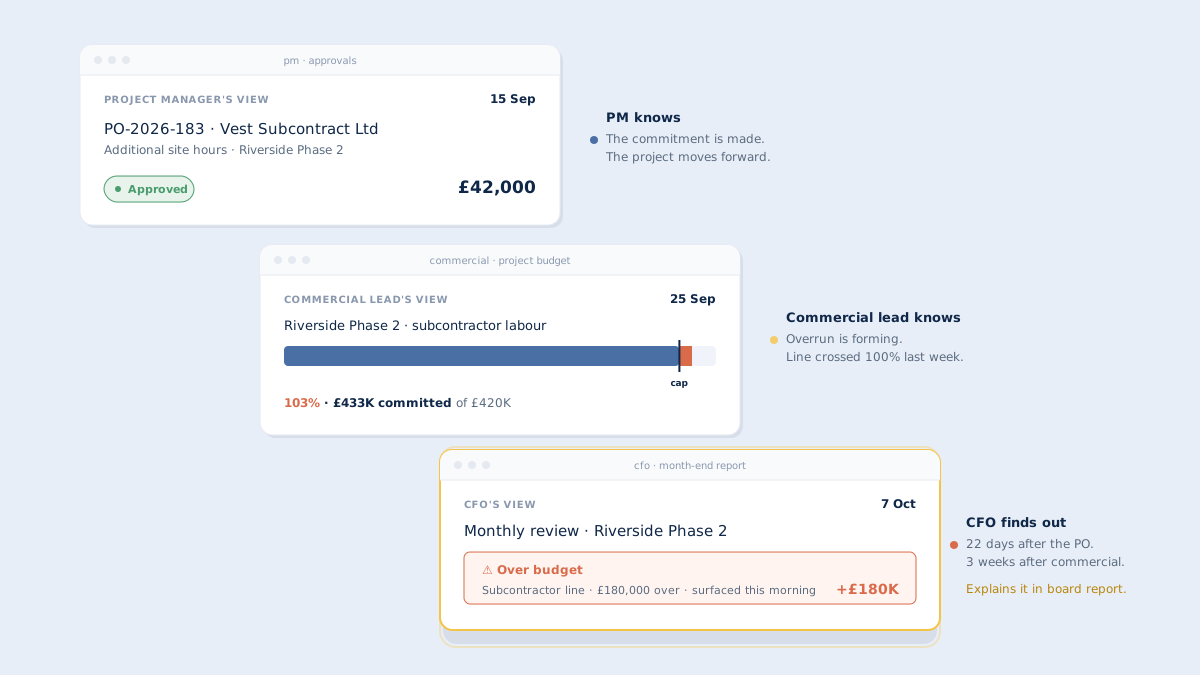
The mechanic that matters for cost control: variations don't replace the original PO — they add to it. So the "committed value" on any PO with variations is the original sum plus the running total of approved changes, and this needs to be visible at any point. If those adjustments are lost in email threads and never reflected in the PO record, the project's committed-cost figure is wrong, and it stays wrong until final account reconciliation — often months after decisions could have been made.
Interim payments
Construction doesn't wait for the whole job to finish before paying. Every month (or fortnightly on larger jobs), the subcontractor submits a valuation of the work done cumulatively to date, that's assessed and certified, and an interim payment goes out for the certified value minus everything paid previously.
The consequence for the PO: a single subcontractor PO might see 12–24 payments over its life. Each has to match back to the same PO with the running paid-to-date and remaining-committed balances staying accurate. That matching relies on every valuation quoting the original PO number. A tool that treats a PO as a single-invoice event breaks down here. One that keeps every invoice and payment tied to the same PO — with the running balance visible to the commercial team — is what makes multi-invoice construction work manageable at scale.
Retentions
Retention is a percentage of each payment held back as security against defects — typically 5%, released in tranches at practical completion and end of the defects liability period (usually 12 months later). It's an industry standard rather than a piece of PO mechanics: for most contractors it lives in the subcontract terms and gets tracked at finance-ledger or subcontract-management level rather than in the PO record itself. Worth understanding as context — the reason a subcontractor's invoice value never quite equals the amount paid — but not usually something the PO tool needs to manage directly.
Approval flows on multi-party projects
On any real construction project, POs go through multiple approvers. Different thresholds trigger different approvers. Here's a common pattern for a mid-size UK contractor:
| PO value | Typical approver chain |
|---|---|
Under £5k | Project manager only |
£5k–25k | Project manager + quantity surveyor |
£25k–100k | PM + QS + commercial director |
Over £100k | Full chain including managing director or board sign-off |
Every business sets its own thresholds. The principle underneath is what matters: as the value at stake grows, more eyes get involved, and each approver is meant to catch a different class of problem. The project manager knows whether the work is actually needed on site now. The quantity surveyor knows whether the price is consistent with the estimate. The commercial director knows whether the PO fits the project's overall margin position.
Skip any of them, and control breaks somewhere. And in a spreadsheet-driven world, skipping is easy — "just approve it, I'll sort the paperwork later" is how a lot of £25k POs get raised as three separate £8k POs to stay below the threshold. Systems that enforce the chain make this discipline stick.
Common problems and how disciplined POs prevent them
The problems that show up on construction cost reports mostly trace back to the same handful of PO-discipline failures. If you recognise these in your own projects, the fix is almost always upstream at the PO stage rather than downstream at the invoice stage:
- Subcontractor started work before the PO was raised. No formal record of scope or price. When a dispute happens at valuation, there's nothing to reference. The fix: no work starts without an approved PO. Systems that block "letters of intent" from being paid without a PO on file solve this at source.
- Variations agreed verbally, never documented. The QS says "yes, add that scope"; nobody writes it down; the subcontractor's final account lists the variation as £14k; the project team has no record; dispute. The fix: variations get their own reference number and go through their own approval, always linked back to the parent PO.
- Multiple site teams ordering the same materials. Two orders for 40 tonnes of rebar because two supervisors both raised the request. The fix: shared visibility of what's already been ordered against each work package, so anyone raising a new PO sees the running total first.
- Interim payment made without matching to variations. The person certifying the interim valuation misses a variation submitted separately — the two paths never met at the approval point. Result: overpayment, arguments at final account. The fix: every variation and every invoice against a PO sit in one place, so the approver sees the full picture before signing off.
- Change orders raised but not approved. A variation gets logged, work happens, but the formal approval never lands. Legal ambiguity — did the client actually agree? The fix: work associated with an unapproved variation doesn't get valued until the approval is on file.
Every one of these is the same underlying problem: the PO isn't being treated as the single source of truth for what was agreed. When it is, the problems become visible earlier — usually when someone tries to do something inconsistent with the PO record and the system asks "wait, are you sure?"
When to move from spreadsheets to a construction PO system
Excel-based PO tracking works fine on small projects with one or two people managing procurement. It stops working around the point most construction businesses hit anyway:
- More than 20–30 active POs on a single project at any one time.
- More than one person raising POs against the same project or work package.
- Surprise costs on the monthly cost report that no one seems to have raised a PO for.
- Variations losing traceability — nobody's sure which are approved, which are in draft, which the client has signed off.
- Payment approvals sitting in inboxes for weeks because the approver can't remember what the PO was for and doesn't have the papers to hand.
- The commercial team spending more time doing paperwork than doing commercial thinking.
Once the symptoms show up, the honest move is to a purpose-built PO system for construction — one that handles interim valuations, retentions, and variations natively, keeps every PO tied to the project's cost breakdown structure, and gives everyone with a stake in cost visibility a live view of committed spend against budget.
CostTracker was built for exactly this shape of work. If you want to see how it handles construction POs specifically — subcontractor commitments against project budgets, multi-approver routing at value thresholds, and the running committed-vs-budget position visible to the commercial team in real time — we've put together the details on our construction cost control page. And if you want to see how the connected pieces fit together, the complete guide to purchase orders covers the foundations, the guide to tracking committed cost covers why real-time PO visibility is the biggest lever a contractor has, and the piece on three-way matching covers how POs, invoices, and delivery records get reconciled at payment.
Frequently asked questions
A construction purchase order is a formal document a contractor uses to commit to buying work, materials, or plant hire against a specific project. Unlike a general PO, it typically covers a package of work over months rather than a single delivery, includes retention held back to practical completion, and is subject to variations as the scope refines during the build.
A subcontractor PO covers a whole package of work — often over months — rather than a single item or delivery. It carries retention, is paid via interim valuations rather than a single invoice, is subject to variations that adjust the price during the project, and typically requires more approvers than a general commercial PO. It's the biggest single category of PO by value on most construction projects.
Retention is a percentage of each payment held back by the client (or main contractor) as security against defects. Typical retention is 5% — half released at practical completion, half at the end of the defects liability period, usually 12 months later. Retention is part of the PO's committed value, but the day-to-day tracking (the payable amount, the retention held back, the eventual release) is typically done at subcontract or finance-ledger level rather than in the PO tool itself.
A variation is a change to the agreed scope after the PO is issued — extra work, changed materials, revised design, or scope reduction. Variations add to the PO's committed value rather than replacing it. On most projects they add 5–15% to the final account. For cost control to work, every variation needs to be linked back to the parent PO and reflected in the committed-cost figure as soon as it's approved.
Usually yes — each subcontractor package gets its own PO so scope, retention, and variations can be tracked separately. Some contractors also use "framework" POs for supplier relationships that will generate multiple call-off orders. Either pattern works; the important thing is that any specific commitment is traceable to its own reference.
A subcontract is the wider commercial agreement between main contractor and subcontractor — governing terms, payment mechanics, insurance, disputes, and so on. A PO is a specific commitment issued under that agreement, covering a defined scope of work with an agreed sum. On smaller packages the two can be combined into a single document; on larger packages the subcontract governs the relationship and multiple POs cover the specific commitments made against it.
They have to. Construction rarely pays a subcontractor a single lump sum at project end. The PO records the total contract sum; interim valuations sit against that PO monthly; each valuation results in an interim payment. A single subcontractor PO commonly sees 12–24 invoices and payments over its life, and they all need to match back to the same PO with the running balance staying accurate. A tool that treats a PO as a single-invoice event isn't fit for construction — one that keeps every invoice and payment tied to the same PO record is.
Real-time cost control in construction projects
CostTracker keeps every PO, invoice, and payment linked to the project's cost breakdown structure — so the commercial team sees the live committed position against budget in real time, rather than reconstructing it from spreadsheets at month-end. Built for construction. Set up in a day.